
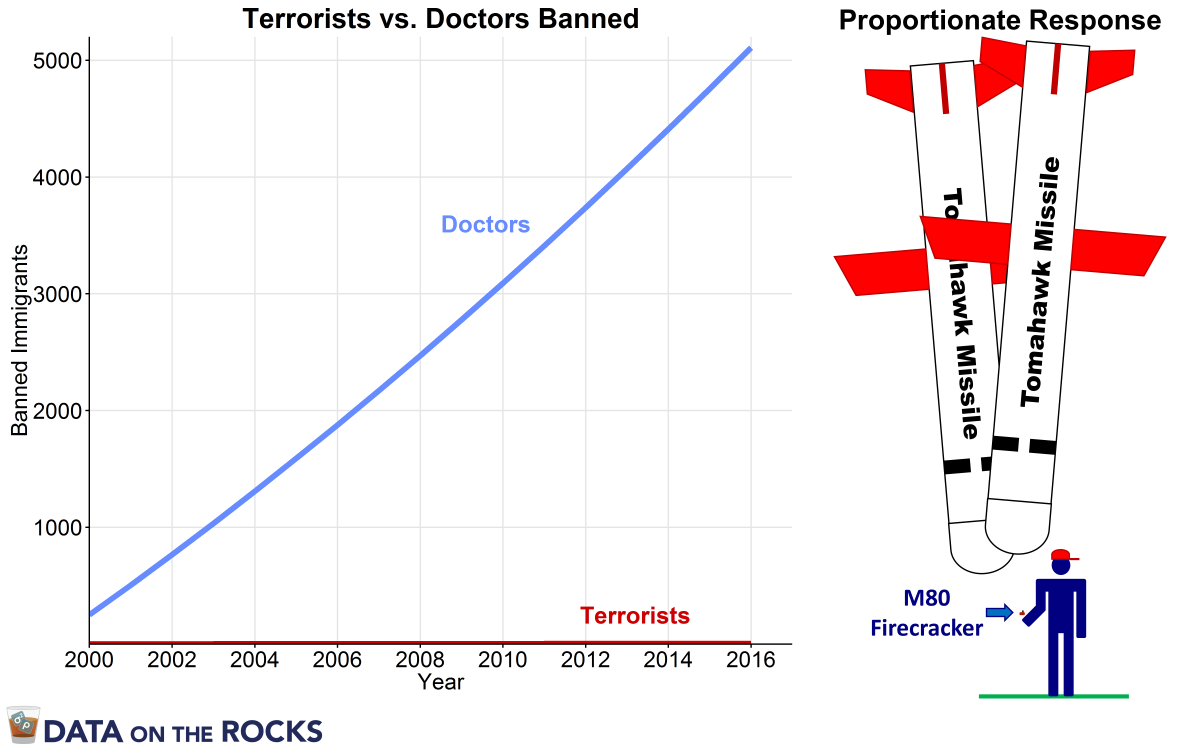
A mere seven days into his presidency, Donald Trump signed an executive order banning immigration and travel from seven majority-Muslim countries: Iran, Iraq, Libya, Syria, Somalia, Sudan and Yemen. Although the executive order is currently being contested in court, it is still on the books and is continuing to affect the lives of those seeking refuge and immigration. Trump claims this executive order was intended to protect the nation, but it would likely hurt Americans overall. The graph on the left shows the effect of an immigration ban on these same countries had it been implemented in 2000, before the September 11th attacks. This immigration ban would have blocked three terrorism events which injured a total of thirty people and killed zero. It would have also blocked immigration for over 5000 doctors, each one of whom does 17 times more to improve the lives of Americans every year than all the terrorists cost put together! For a comparison, this is like trying to stop your teenage neighbor from setting off a single M80 firework by hitting him with not one, but two Tomahawk cruise missiles!
For the data wonks
- The three terrorist events are: (1) On March 3, 2006 in Chapel Hill NC an Iranian man hit 9 people with an SUV. Six were hospitalized for minor injuries. goo.gl/lp7hJu (2) On September 17, 2016 in St. Cloud MI a Somali man stabbed 10 people at a mall, none of whom suffered life-threatening injuries. goo.gl/mRhdhP (3) On November 28 2016 a Somali man rammed a car into pedestrians on a sidewalk at Ohio State before stabbing several people. A total of 11 people were treated for non-life-threatening injuries. goo.gl/IZ69u3 The cumulative number of terrorists who would have been blocked by the hypothetical 2000 ban is plotted in red.
- Writing for fivethirtyeight.com Dr. Jena and his colleagues from Harvard University used data from Doximity.com, an online professional network for physicians, to calculate that 8,243 physicians currently working in the United States went to medical school in countries that are banned under Trump’s executive order.
- To estimate the number of doctors that would have been affected by the hypothetical 2000 ban, the total number of immigrants from the 7 banned countries was analyzed using country level immigration data collected by the US Census and the American Community Survey (downloaded from goo.gl/NxJPnd). A quadratic time trend was found to fit the total immigration data extremely well (R2 = 0.9997), and was thus used to estimate the number of people from the banned countries who immigrated to the United States each year. Using the number of practicing doctors from the banned countries (8,243), the proportion of the total immigrants from these countries who are doctors was computed (1.19%). This ratio was then multiplied by the number of new immigrants from banned countries each year to compute the number of doctors who would be banned each year. The cumulative total of new doctors from banned countries by year is plotted in blue on the graph. By this math, a total of 5,107 doctors would have been banned from immigrating to the United States.
- To enable direct comparisons between the positive effects of doctors versus the negative effect of terrorists, both effects were converted into units of quality adjusted life years (QALY). One QALY is equivalent to one year of disability free life and is a common metric in health policy research.
- The terrorist events injured a total of 30 people with non-life-threatening injuries. Dr. Dolan and colleagues from the London School of Economics have estimated the cost of various crimes in terms of QALY (goo.gl/PLcJwG) and concluded that an assault resulting in “other wounding,” a reasonable mid-level estimate for the terrorism victims costs 0.031 per victim. Thus, altogether these three terrorism events cost an estimated 0.93 QALY.
- Lewis, writing for the 80,000 Hours blog, estimated the QALY gain for an average practicing doctor (goo.gl/gwPHbD). After taking into account marginal returns, and the effect of replacement (i.e. supply-demand economics), the final QALY estimate of a doctor in a developed western country is around 600 QALYs over the course of a career. Given that the average doctor’s career is 35 years (goo.gl/UEqP3M), the effect a doctor has in terms of QALY is about 17 QALY per doctor per year.
- To estimate the QALY that would be lost from a ban placed in 2000, the number of new doctors each year who would have been banned was multiplied by the number of years they would have worked through 2016 and the estimated 17 QALY per doctor per year. These values were then summed over the years 2000 to 2016 resulting in a final estimate of 649,561 QALY gained from immigrant doctors from banned countries.
- The final ratio for comparison between QALY gains and losses due to doctors and terrorists respectively was 698,453:1.
- A single M80 firecracker contains 3g black powder explosive (goo.gl/mbHlpY) which is equivalent to 0.00165 kg of TNT (goo.gl/Xshuzw). Multiplied by the ratio of doctor gains to terrorist losses results in 1,152 kg of TNT. By comparison, a Tomahawk cruise missile is estimated to have the explosive power of approximately 500 kg TNT (goo.gl/cqxeeG), therefore 2 Tomahawk missiles is roughly equivalent in proportion to an M80 firecracker.
 Data on the Rocks