
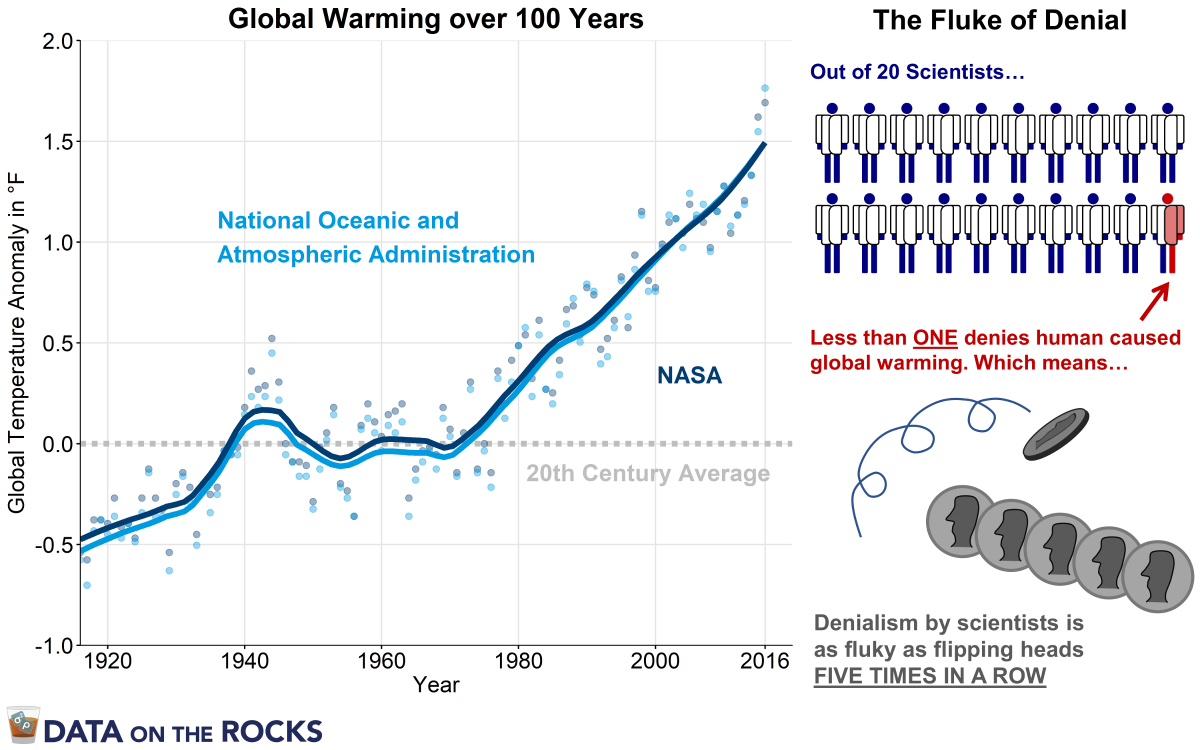
As summer approaches and Trump considers withdrawing from the Paris Climate Agreement, it is worth looking at some data on global warming. The graph on the left shows global temperature change over the past 100 years measured by both NASA and the National Oceanic and Atmospheric Administration (NOAA). Though the temperature bounces around year-to-year, the overall trend is clearly a steady and dramatic rise from about 1970 on. Based on these and other data, a staggering 97% of climate scientists and scientific studies endorse human-caused global warming that is directly related to CO2 and other greenhouse gases. This scientific consensus means that finding a climate scientist who denies human-caused global warming is just as fluky as flipping a coin five times, and getting heads each and every time. In stark contrast, only 69% of Democrats and a mere 23% of Republicans agree with this scientific consensus.
Category: science
Science Funding
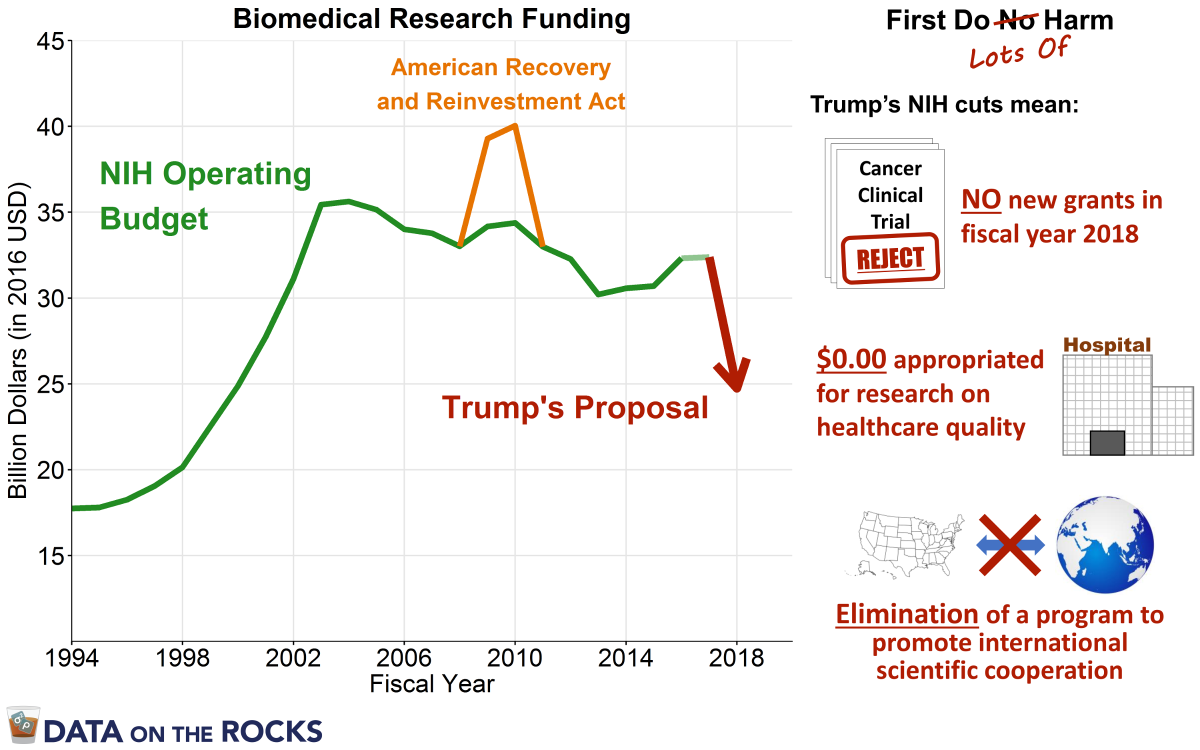
Yesterday, tens of thousands of people across the United States and the world marched in support of scientific research at the March for Science. This march took place almost exactly a month after President Trump revealed his budget request to Congress. Trump’s budget included startling cuts to nearly all scientific research agencies including the National Institutes of Health (NIH). The NIH is the largest biomedical research organization in the world. NIH directly employs over 5,000 of the world’s smartest biomedical researchers, and through scientific grants, is the backbone for biomedical research across the country. The graph on the left shows the operating budget of the NIH from 1994 to today (inflation adjusted), including the effect of the American Recovery and Reinvestment Act and Trump’s proposed $6+ billion cut. The negative consequences of Trump’s proposal are frankly hard to overstate. To start, there would be no funding available for new grants in fiscal year 2018. No money would be allocated to study healthcare quality. And a program vital to fostering international collaboration would be eliminated. As Kathy Hudson, a former deputy director at NIH put it to the American Association for the Advancement of Science, “The nation would lose research and researchers in a way that would not be recoverable.”
 Data on the Rocks